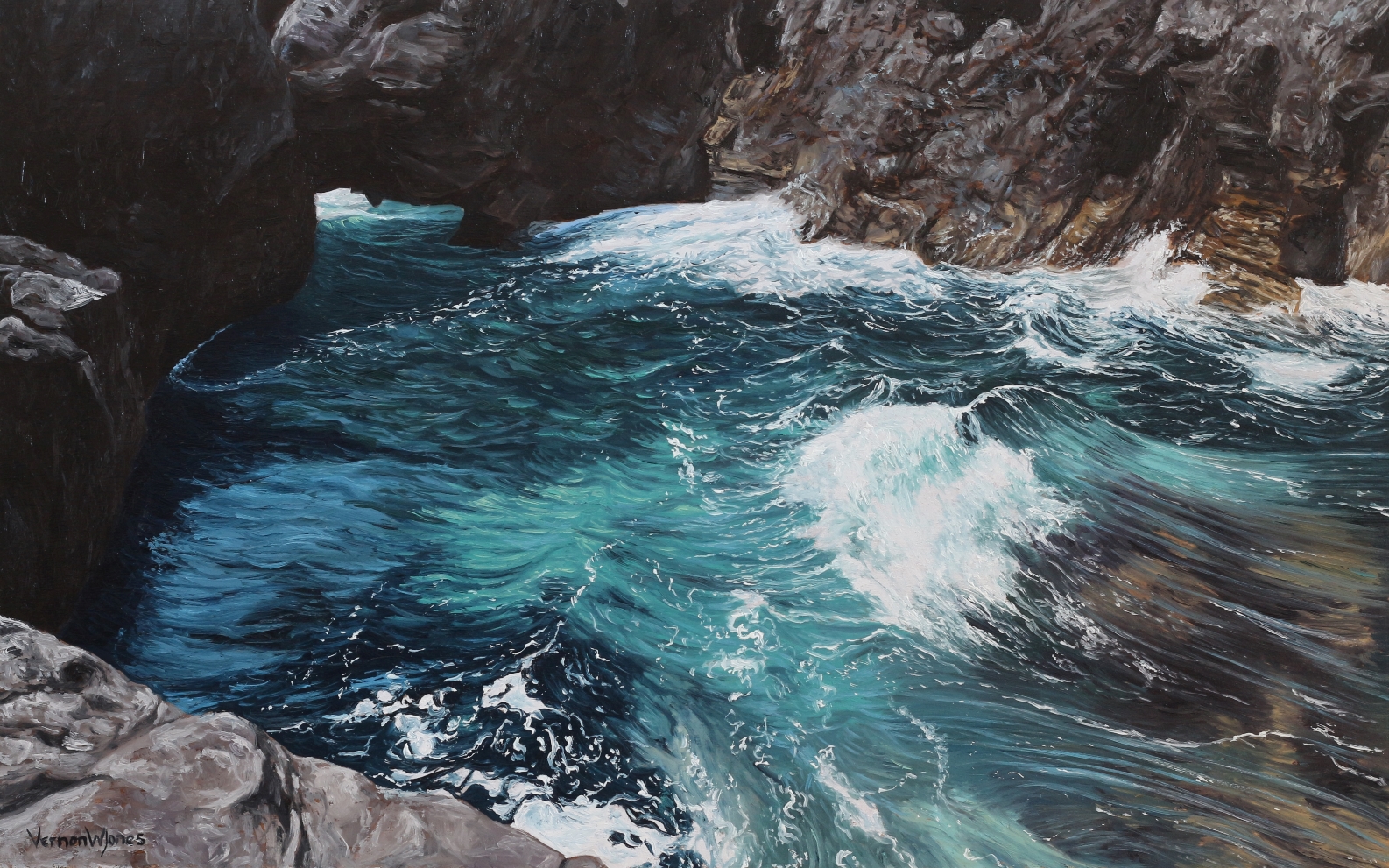
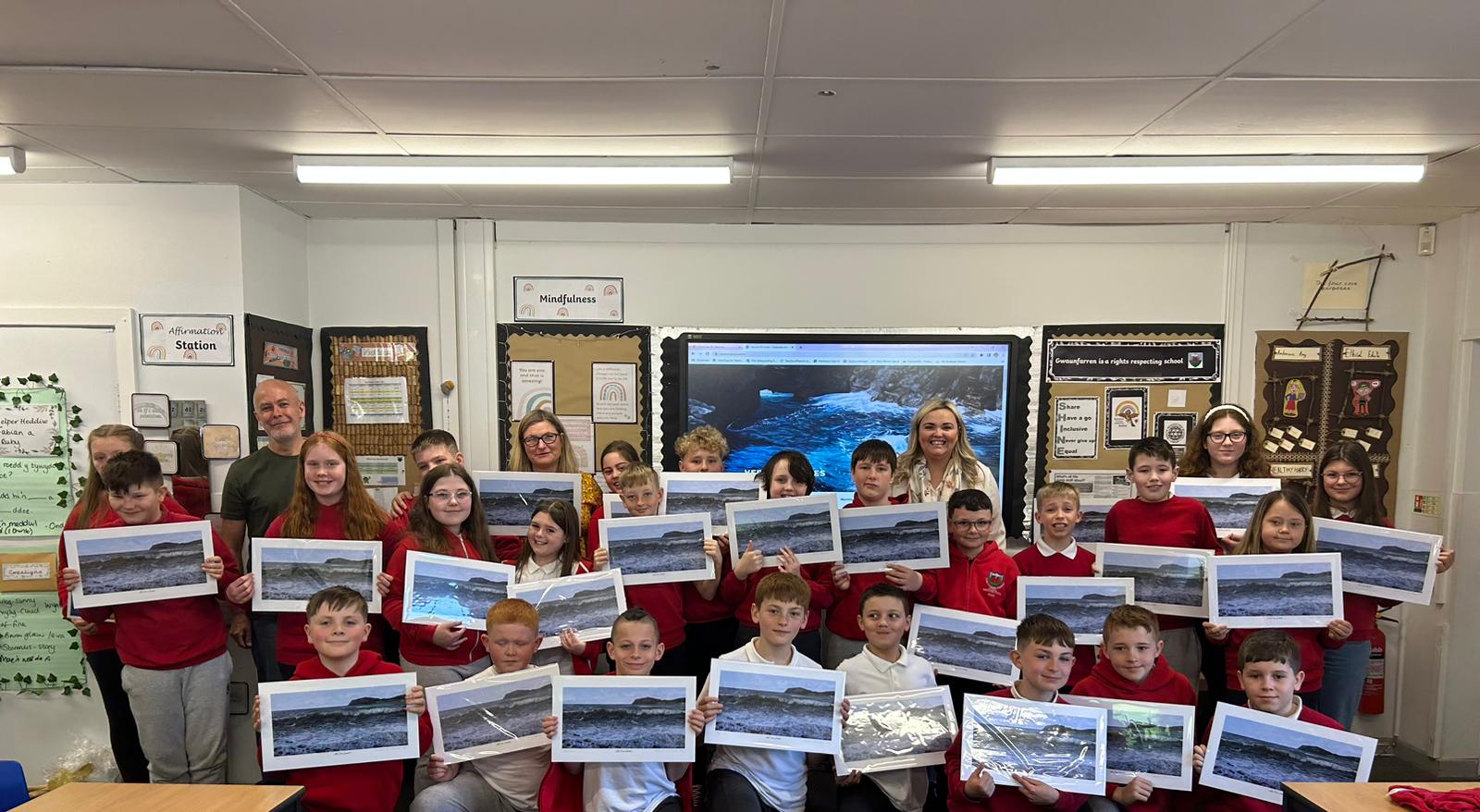
These are the paintings produced by Year 6 of Gwaunfarren School, Merthyr Tydfil in South Wales U.K. for an art competition for me to judge. The children were supervised by their teacher Miss J Warren who is very proud of their achievements and who organised the competition.
Below the gallery for the winner and runners up.
Here is the gallery of the young artists work, 1 – 26
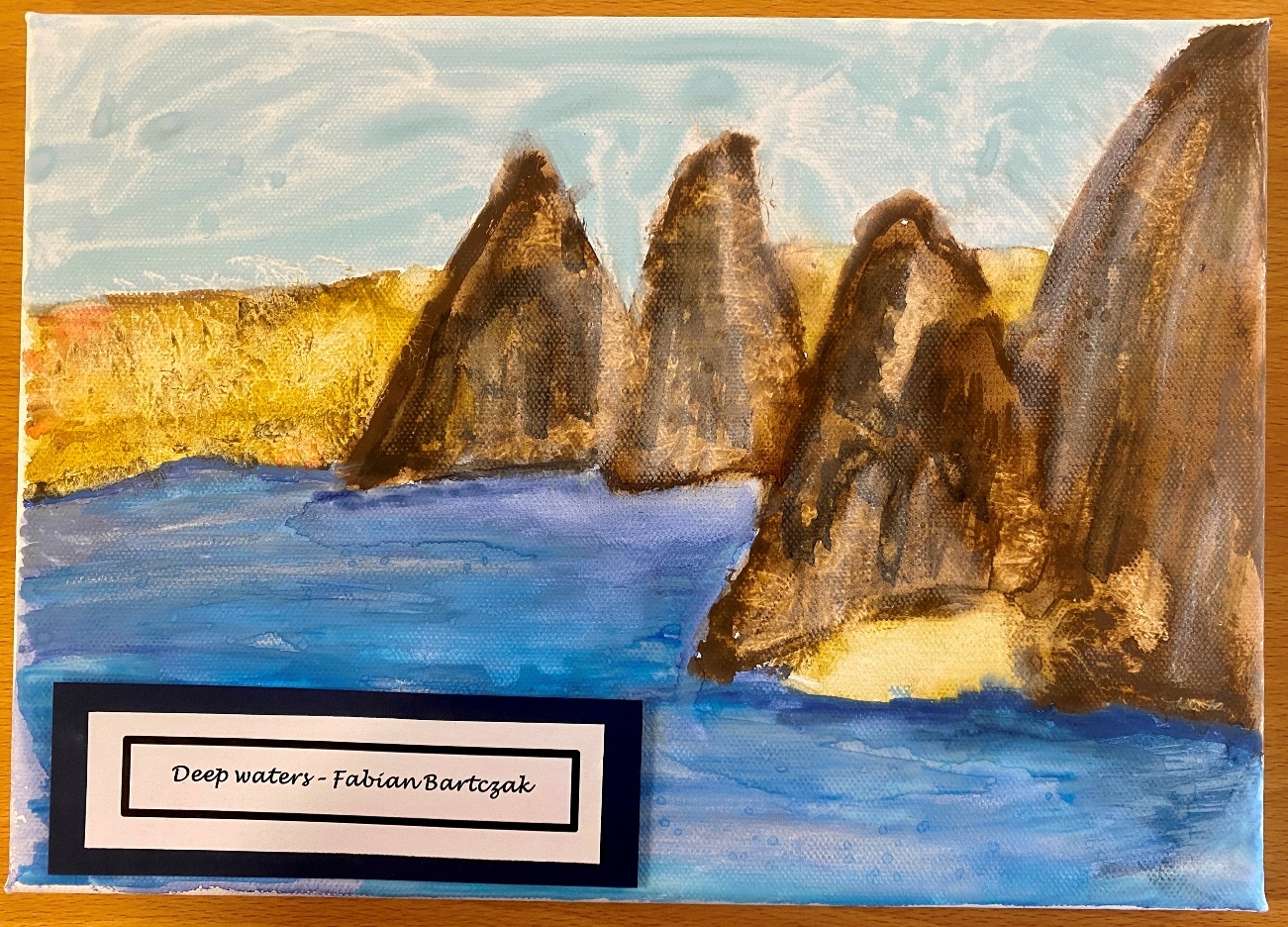
On April 20th 2023 all children were presented with signed, embossed and dedicated to each young artist prints to say congratulations for the great work they had all created. Since it was a competition that I had been asked to judge, I made my best decisions and it wasn’t easy by any means! For those who didn’t win, please don’t be disheartened. Not winning doesn’t mean you are not good, maybe next time you will win. Giving your best is something no one can take from you, and you can carry that in your heart that you did your best. Never stop trying if it’s your dream, your wish.
The 5 awards…
In order:
1st Place Prize of a Limited Edition Print signed and embossed and an Original Acrylic on Canvas Painting.
Arran Cunningham
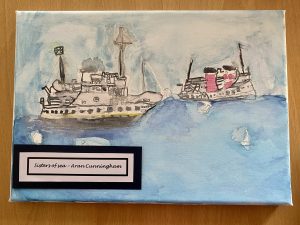
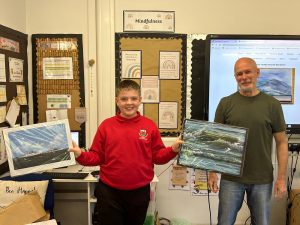
Notes: The most impressive part for me is the attention to detail. The birds with their various shaped wings, the flags, the cables, the paddle of the Waverley, port holes, the land – Arran has really looked hard at this one and positioned the ships well in the composition with beautiful and subtle colouring and dramatic sky. It’s wonderful that you have worked right to the edge of the canvas the same as the other 3 I have picked out. Very well done!
2nd place (extremely close 2nd) prize of a Limited Edition Print signed and embossed.
Ella Slimmon
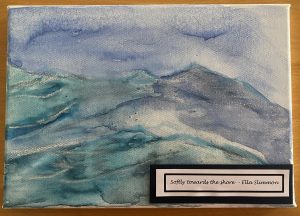
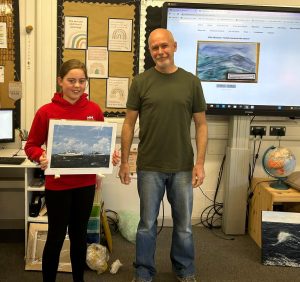
Notes: I think the colouring is beautifully done, with a lovely shape to the sea. It has a very nice “painterly” effect, the top left for example. the deeper blue in the sea moving to the greener sea in the centre, and that nice drying effect of the paint with great movement. Very well done!
Joint 3rd prizes of Limited Edition Prints signed and embossed.
Mia Chambers
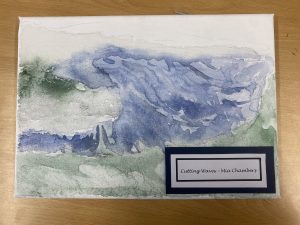
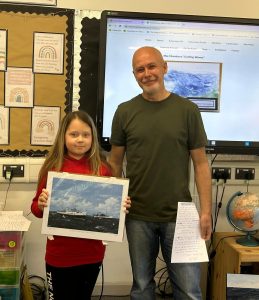
Notes: My eyes are drawn to the overall effect of this piece of art. I love the effect of the paint and the numerous brush strokes as you create the action of the water, especially the green to the left with that blurred effect allowing the paint to work for you. The fade at the top suits the painting very much. Great Job!
&
Ollie Jones
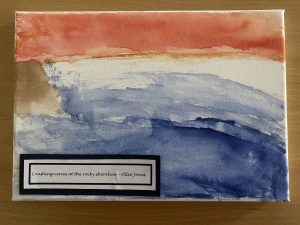
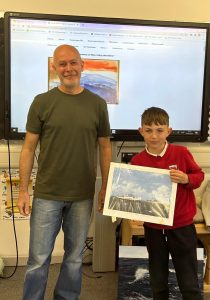
Notes: Bang! That orange – amazing! Very bold piece of art, it looks to me that you are not afraid of bold colours, which isn’t always easy to do – but you have done this extremely well, and well done for that. I also love the way you left the brush strokes in the centre of the painting to create a brilliant effect, and the deeper blue tone to the bottom to give depth. Very striking piece. Great Job!
The “Mothers Award” of a Limited Edition Print signed and embossed.
Ollie Ward
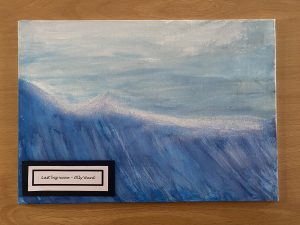
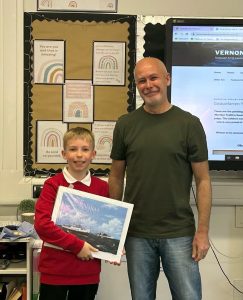
Notes: When I made the very hard job to select from all the paintings, I had to narrow it down which was to 8, and from there to select. This piece was in that 8. It has skillful lines to show the movement, the foam is very well done, the deep contrast of the blue in the foreground, and the faded out background. A piece nicely done, kept the paint to the edges, and good observation. Well done indeed!
My mother who picked this one has a very good eye of composition and is used to my works, so this goes well deserved. Her words were “it reminds me of something you would do”.
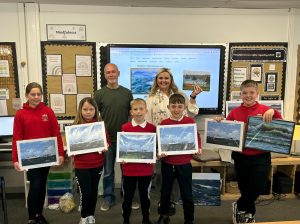
Here are the prize winners together with Teacher Miss J Warren who can be seen holding her Limited Edition copy of mine and Josh courts book “North Coast 500 Midges and all” to say thankyou for all of her hard work putting this together.
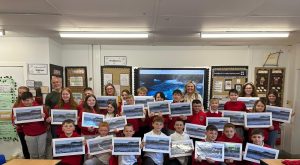
Here is the class (most were present)
…AND then they surprised me with a gift to say thankyou, a huge card signed by everyone and a tankard with, well…here take a look!
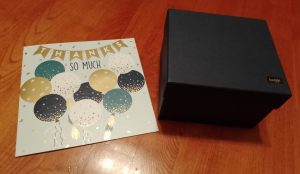
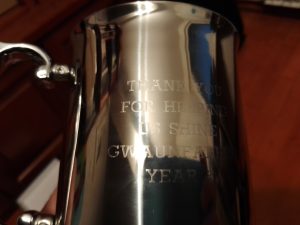
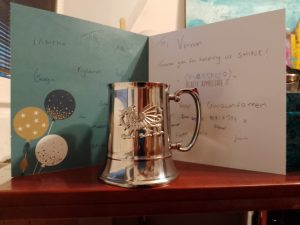
The inscription reads “Thankyou for helping us shine, Gwaunfarren school year 6”
I was very surprised and touched by the thought from everyone, it means a lot to me.
Thankyou.
As promised, the Tankard in Macedonia Vid 🙂
This post went out about the day from Miss J Warren.
“Our children bounced into class this morning ready to meet seascape artist Vernon Jones 🎨
Miss Warren & Mrs Evans”
Once again, EVERYBODY well done!!
…………………………………………………………………………………………………………….
…………………………………………………………………………………………………………….
Gwaunfarren Year 6. Our questions for Vernon Jones
These were questions prepared for an online meeting with me from the school. I did answer those questions “on the spot”, but I wanted to put them here with the questions asked.
Alfie Jay Hindley
Q. How long have you been painting?
A. I have been painting since 1999 as I consider it. Before that time I was using paints of course, but was definitely more into pencil work and illustrative works going to Illustration college (with design) 1992 to 1994 HND. Painting felt different in 1999, where the works, as far as I can remember, were being prepared for a gallery, and I began this road as a gallery artist from then on, something quite unexpected! I still like to do Illustrative works today, but I would say I am also a painter as well as I am an artist.
Aran Cunningham
Q. How would you motivate young artists?
A. Competitions are good to get involved in, a good test of your abilities (you have to do your best to try to win) and I think keep trying your best anyway also for yourself. If you can’t do something learn how to do it, have patience, and aspire to who you want to be.
Not a bad thing to aspire to artists too. I was (and still remain) a metal fan, especially loving the album covers and the artworks, and especially those from Derek Riggs and his Iron Maiden artwork which I still appreciate. In these years as a seascape painter it has been J Steven Dews and his J class yachts, one of the best in the world. There are a few artists online I am in contact with who also are brilliant, and some friends I have too.
My goal while learning how to paint the sea was to understand how he (J.S.Dews) did it, to study, try to work it out. Time hasn’t changed that learning process from a young boy to today for me. Learning and reaching further ahead doesn’t stop if you want to get better and know more. Don’t give up!
Ashton Thomas
Q. How do you feel when you have finished a painting?
A. That’s a big field, and depends on many things really. I can feel sometimes a bit disappointed that something didn’t work out as well as I had hoped, I can feel very happy and maybe even surprised by the result in a good way, excited by it. I can feel that I got it right, or that the result is interesting and maybe quite unexpected as when experimenting. In general things are on an even keel, so I am pleased that I got it right. Then there are ones that are quite exhausting to do, with lots of problems to solve.
Those things aside, and when I take the time (not very often) to see what I am doing from the outside a little, it is of course a beautiful feeling to be able to create from nothing. The process is magical and a person has to be happy that they are able to do something like this, fortunate. Even so, and regardless of natural talent or not, there is work to be done.
Bogdan Mitrowski
Q. Which piece was your favourite to paint and why?
A. One of my favourite pieces is one I just completed of the Knight I made into Bronze and into a huge figure in the sea. I got a chance to spend 6 weeks on this one, so no pressure on me with money or time, and to do exactly what I wanted, even if it was quite a tough one and a challenge too. Plus also it was going to be used as a band cd cover so it had a very definite purpose. The whole concept interested me, it had everything I loved to do in it.
I had already made a painting that really served as a sketch in a way for this one, so had the idea already, and the band had their eye on it! I wanted to make it better, and so after a short discussion with the band I got on with it. My only regret with tis piece is that I didn’t make it bigger. It was still over a metre long, but really needed to do it double the size just to help me out with the details.
Ella May Slimmon
Q. What paint do you use most?
A. Although it largely depends on what I am doing, I would say rather oil over acrylic. I love oil very much, and the colours are alot more solid for me to use, plus there are some technicalities to be aware of which is interesting, layering being very important. The drying time is quite easy to get around, work on various paintings at the same time and there is always something to do.
Fabian Bartczak
Q. Can you offer any tips on how to draw a footballer?
A. If I was going to draw a footballer I would firstly research and get all the information that I wanted so that it’s the one I want. The reference needs to be clear so that you can see all the details. There are various ways to get the image onto your paper of canvas, but first design the composition, the footballer must sit inside that frame somewhere. You can freehand it, you can transfer the image using a variety of techniques, but make sure that the guide lines are not heavy, as you may need to rub them out. Then you get to work on it taking care to create good lines.
Finn McCarthy
Q. Is there any tips you can give me to make water look like its moving?
A. Yes, a big question, and one that I have worked on for years and years (with the sea). When I first began with the sea I had no idea what I was doing, and the subject was enormous! So I studied, and I also had help from an artist who was mentoring me for 2 years. My study was also how did another artist achieve that. Then I had to try to translate the sea, so had to build up my skills along the way. I watched the sea, scrutinized pictures of it, comparing it to other artworks to find out how it was translated, what are the clues I need to find.
If you can understand something in your mind, to answer the “why”, it helps so much, as I think I was partially blind because I couldn’t see the why, I didn’t know how to see it. Then you do see it, and it’s amazing, you are getting somewhere, and you are learning the techniques to get you to where you want to be. You have to find a way to relate to the subject, and must know how to apply the paint, brushes to use etc.. Look for angles, shapes, and understand these, understand that there is a reason for every ripple to exist, and you need to show that ripple making sense in its place. There is the bigger picture to consider, that one thing affects another, and another, and another. When you see that cause and effect happening, it will help you to translate that into your work.
The actual translation itself is another “problem”, and that’s what honing your skills is all about.
Fletcher Duggan
Q. What’s your favourite painting by any artist?
A. I love the work of John William Waterhouse for example, “The Lady of Shallot” a masterpiece for me. Everything about it is fantastic, so much detail, and a story within that work.
Georgie Edwards
Q. Which paints best capture water movement?
A. I got started with oils when learning to paint J class yachts and the formidable opponent of the sea at the time. I still prefer them over other paints because of the control I have with them, their look too. But each to their own of course, I can also get a great result with acrylics, but ultimately I will go for oils anytime for a best result.
Gracjan Halas
Q. Which water species is your favourite?
A. Probably I would say trout to that one, being elegant, with beautiful colouring, and great to catch! There are many water creatures that are beautiful, but the trout is a lovely fish, the rainbow trout especially.
Hadley Collins
Q. What’s your favourite thing about the ocean?
A. It has to be a storm for me. I can’t think of anything better than to watch a storm on the sea, huge waves going everywhere, sheer power, the sounds around. Wonderful. That’s the work I love to do the most, to capture nature in this way.
Holly Jones
Q. Where do you create your art?
A. I create usually in my studio as most of my work is studio based, 99.9 percent really. I have started to get out painting, and will go again when the weather is ok (time of writing is March) and paint onsite which I have learned to do in my studio, the technique to paint in a single layer in oils is called “Alla Prima”. It gives a different result from studio work, and that difference must be accepted and “allowed” in the mind as its own right.
Ioan Jones
Q. What Inspired you to become an artist?
A. I always wanted to be an artist as I loved to create. I don’t know why I was this way and why it was that I was attracted to it, but I always loved art and making things. My family were always supportive, my teachers too, and I was competitive, which I still am today against myself! I just kept at it, drawing and creating. Maybe it was in the genes as in my family on both sides are people good at working with their hands in various professions, including one who was head of an art department. Maybe there simply was no escape (said jokingly).
Joseph Thomas
Q. When did You seriously start your career as an artist?
A. I believe that was 2005 when I became self employed as an artist, quite a scary leap to take as I didn’t know what the future held, was I going to be able to survive as an artist! Before that I was doing it anyway and working as an artist between jobs and travelling, plus as I said doing it anyway, but that decision in 2005 was a big commitment and I had to really go for it!
It was taking the plunge, a “do or die” moment, and perhaps the biggest part of it was to have faith in myself and my abilities.
Kylan Hellard
Q. How old were you when you first started painting and drawing?
A. I don’t have any memory of that I am afraid, only that as far as I can remember I was drawing and painting, which I can go back to about seven years old I think. I was taking part in school competitions, drawing on my school book covers (wasn’t supposed to do that), drawing with my friend etc.
Leila Thomas
Q. How do you make the waves look like they are crashing down on the shore?
A. The answer to this are you first have to look for clues. For example, we all know what a chair looks like on the floor. We all know that it is on the floor, but have you ever thought what clues are telling you that it’s on the floor, and not floating a foot above the floor for example? What tells you its next to a wall? We all know where it is, but what tells you that? Then you have to translate that info. and knowledge.
The same with a wave crashing to the floor. Impact lines and forms, spray, the way the foam looks, the shadows between the sand and the foam for example. Clues. There are clues everywhere that tells us where things are and what’s going on, and if you look around you at all times everything is where it is, and there are clues that tell us that. An artist I think needs to find these clues, to know what they must search for to translate the scene.
Martha Keohane
Q. What or who Inspired you to start painting?
A. If we are talking about the very beginning of my art life I just loved it, and had the support from my family and my teachers. My father would show me some things that was inspiring. I loved album cover designs, that definitely inspired me a lot. I also loved Romans and Normans back then too, Knights jousting (I still do), so trying to draw those things were interesting. I also liked to draw natural things like sticks and buds a little later on, streams, and also old stone walls, churches, buildings in the comprehensive school, then portraits and figurative works in my first art college.
If we are talking about what I consider to be painting as I mentioned in 1999, the prospect of making an exhibition I believe inspired painting.
McKenzie McCarthy
Q. How long has your longest piece taken?
A. That was around 2 and a half to 3 months I think, a painting of the Western Rocks on the Scilly Isles. It was 2.6 metres long and a lot of detail indeed.
I had to take great care with the entire piece, as even the rocks in the background had names due to ship wrecks I think. It was a commissioned piece in which I travelled out there to get the references over 3 days I believe, and was able to bring back 8 different light sources for the customer to select from. The whole trip took 5 days, I enjoyed every second of it from train, boat, b and b’s – great fun!
Mia Chambers
Q. What is your favourite art piece ever?
A. Fletcher asked this question unless I have mistaken your intent. It does give me the opportunity to give another example of work I like. In my mind right now is the album cover from Iron Maidens “Somewhere in time” album by Derek Riggs. It is also a masterpiece. Go on then, one more. How about William Turner’s “Snow Storm: Hannibal and his Army Crossing the Alps”. That is an amazing piece too!
Ollie Jones
Q. What is the cheapest painting you have ever sold?
A. Apart from giving away work, maybe £5.00 off the top of my head, but that would be quite small indeed!
Olly Ward
Q. What are the best pencils or colours you have ever used?
A. The best coloured pencils I have ever used would have to go to Karisma. They are very expensive now to buy. Watercolours would have to go to a Russian brand, St. Petersburg White Nights (I think they were), watercolour inks were maybe windsor and newton, not sure. Acrylics I would say amsterdam ones and windsor and newton, the same for oil paints, more windsor and newton. But I am sure I am not as well versed in these things, but these mentioned do and have done the job as I wanted.
Added note: I do own some Michael Harding oils that I have yet to use, and there are up there as the best you can find.
Ruben Little
Q. How much did you sell your most expensive painting for?
A. That is something I answered in the class meeting along with all these other questions, but won’t publish that here I am sure you understand.
A lot more than my cheapest one though that I mentioned! One thing that I will say, it was nice, very nice for me to reach that figure that I did, as it felt also like without compromise I had got the value given back to me what I had worked for (not just the actual piece, my life’s work). And this isn’t to take anything away from other sales, I respect them all (in one way almost all) as people are giving their money and keeping me going. In contrast to that sale and relating to “almost all”, I also witnessed a sale where I felt like I had been robbed, even if there was money that was going to help my wife and I, I walked away from the sale feeling very down. The respect wasn’t there, just people trying to get what they could out of me I felt. So I know the difference and it’s good to know these things, to have that contrast.
Ruby Mae Horrell
Q. What was your first painting ever?
A. For some reason in my mind is when I painted the “Ivanhoe” book cover, I must have been about 10 maybe. Was it paints? I can’t be so certain, I think so! Around 10 years old I believe. I loved to work on it, I loved the subject, and it was hard to do, but I still had a go. I sent it off to Tony Hart I think for some competition.
Ryland Nicholson
Q. What has been your most challenging painting yet?
A. When I was learning to paint the seas that was extremely challenging work, and I probably lost a lot of hair in that time! But it must be said abstract work I find challenging. I think our brains are wired a certain way, and that allows us to do this or to do that. Some people I think are just made to create abstract works, and others to create hyper realistic works for example. I struggle a lot with abstract works and yet I can paint and draw pretty realistically. It’s strange, but true.
I am sorry I haven’t given you a specific one. I painted a 4 metre by 2 metre painting, and that wasn’t as challenging as an abstract cormorant picture I am working on that’s maybe 60cm x 40cm. Once you know what you are doing it’s ok I think, even if it takes more time due to scale it doesn’t mean it’s a challenge unless the time limit itself presents one. With the abstract I don’t know what I am doing.
Perhaps then I can mention a painting of a J Class yacht that I was doing under supervision, a monthly review for a critique of my work from someone who knew what they were doing. My sea was described as “worms”, which is funny I know, but I couldn’t do it. I could not paint that sea! I tried and tried, making progress in drips and drabs. I was told about a way to hold the brush by the same artist and how to manipulate the brush, never shown, and started to find my way through the fog over the next couple of years. But those early ones were so hard to do. Then your eyes start to open, you see something and you are able to translate it, and it gives you another push forward. Nothing was going to stop me from doing that, I has entirely hooked, and wanted to get it right! Once our 2 years finished, I took it upon myself to continue, and since the sea was clearly my problem, I focussed on that, telling myself that “If I can make this work with nothing but the sea, then I have cracked it!” And that’s exactly what I did, I kept at it until it worked by itself.
Tilly Llewellyn
Q. How long would it take you to do one painting?
A. I would expect typically a painting in oils around 100cm x 50cm to take around 8 -10 days. Then again I did spend 2.5 to 3 months on one 100cm x 260cm, 5 weeks on a piece that was 150cm x 450cm long…and 6 weeks on one 111cm x 46cm. Depends on the intensity of the work, also it depends on me too if I am full of health or maybe dragging my feet a bit. Depends. But there are a few examples anyway.
Zuzanna Stypka
Q. What’s the best advice you’ve been given as an artist?
A. I am not sure what that would be from anyone particular, although I have always had encouragement from the family and teachers, lecturers and friends.
In my mind is to say maybe that which comes from within me, one where I don’t give up easily and fight to keep going, practise your skills and learn from those around you and from yourself. Learn from your mistakes, be prepared to make mistakes, don’t be afraid to try, and bring to light that which is in your mind, that meaning create what is in your mind, or a feeling in you, find a way to manifest it. Make your weaknesses strengths as much as you can. Learn techniques, the more you can do, the more you can do! And enjoy yourself too, work hard, see what you need that holding you back and change that artistically.
Respect yourself and others.
………………………………………………………………….
Have enjoyed reading through this very good questions and answers
cheers 🙂
Nice one Vernon. Don’t envy you having to judge that competition!
Yes I know, they all made a great job.